熔盐氧化处理核电站放射性废树脂挑战与对策

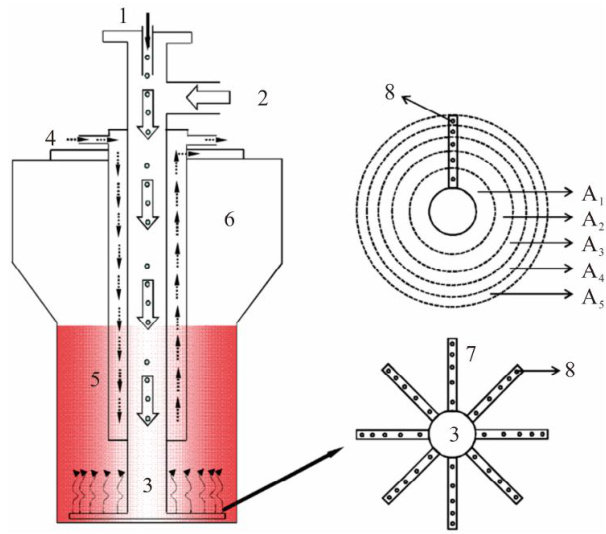
打开文本图片集
关键词:放射性废树脂;熔盐氧化;腐蚀控制;优化设计;废物处理;废盐复用;反应器中图分类号:TQ028;TQ009;TL941 文献标志码:A 文章编号:1671-0460(2026)01-0198-05
Abstract: To promote the engineering application of molten salt oxidation (MSO) technology in treating radioactive waste resin from nuclear power plants,an in-depth analysis was conducted on the core challenges and solutions faced in its current stage.By sorting out laboratory research, pilot operation data,and relevant patent technologies at home and abroad, keyrestrictivefactors suchas waste resinfeedcontrol, process parameter matching,equipmentcorrosion behavior,and system engineering scaling-up were analyzed.The results showed that the current challenges of MSO technology were concentrated inaspects including the dynamic regulation of gas flow during the reaction process, the uniformityofwasteresin feed,thecorrosionresistanceofequipment materials,the staged controlofacid gasesand the retentio efficiency of volatile nuclides (such as Cs). On this basis, a series of engineering optimization paths were proposed, including process parameter optimization,development ofDCS linkage controlsystem, improvementoffeed structure, multi-stage purification of acid gases, modeling of 50kg⋅h-1 scale reactor based on numerical simulation, and waste salt recycling process.This study clarified the key technical nodes forthe large-scale application of MSO technology.
Key words: Radioactive spentresin; Molten salt oxidation; Corrosion control; Optimal design; Waste treatment; Waste salt reuse; Reactor
核能作为清洁能源的核心构成,其发展伴随大量放射性废离子交换树脂产生,单台AP1000堆型年排放量达到 11.33m3 ,占湿固体废物总量的52.3%[1] 。(剩余9776字)