文化差异对产教融合绩效的影响机制与对策提出

打开文本图片集
EmpiricalTheoretical Model Researchonthe Impactof Cultural Diferences onthe Performance of Industry-Education IntegrationinHigherVocationalEducation
WANGJianping (ZheJiangDongFangPolytechnic,325ooo,Wenzhou,Zhejiang,China)
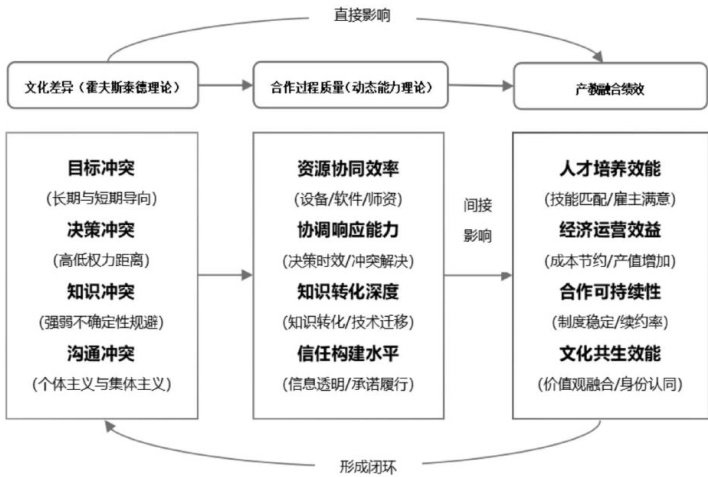
Abstract:This paper focuses on the issue of cultural differences in/the performance of industry-education integration.Current research often focuses on the value and conflict manifestations of cultural integration,but seldomdelvesintotheunderlying mechanisms.Thestudydefines four coredimensions of cultural differences and constructs anempirical theoretical model of“cultural differences-cooperation processindustry-educationintegrationperformance".This model revealsthat cultural conflictsaffectthe fourdimensions of industry-education integration performance,namely/talent cultivation efficiency,economic operational benefits,cooperationsustainability,andcultural synergyeffectiveness,through fourtransmissionvariables:resource coordination efficiency,coordination response capability,depth of knowledge transformation,and trust building level. Based on Hofstede's cultural dimensions theory and dynamic capability theory,a perception-capture-reconstruction mechanism path is constructed. Six optimization measures,including policyadvocacy,strategic consensus achievement,entityculture construction,governance structure optimization,executive teamintegration,andtheestablishment ofanindustry mentor training mechanism,are implemented toeffectively promote cultural synergy between schoolsand enterprises and facilitate deep integrationiof industry and education.
Keywords:Cultural Differences;Cooperation Quality:Industry-Education Integration Performance;Dimensional Analysis;MechanismOf Action
近年来,国家陆续出台了一系列政策文件来推动产教融合发展。(剩余6884字)