基于农耕文化的乡镇广场景观设计实践

打开文本图片集
关键词农耕文化;农业文化景观;广场景观设计;景观节点
中图分类号TU985.1 文献标志码A 文章编号 1007-7731(2026)02-0081-05
DOI号10.16377/j.cnki.issn1007-7731.2026.02.021
Practice of town square landscape design based on agricultural culture
Luo Mei Tu Xincheng Wang Chenxin (School of Biology and Food Engineering,Fuyang Normal University,Fuyang 236O37,China)
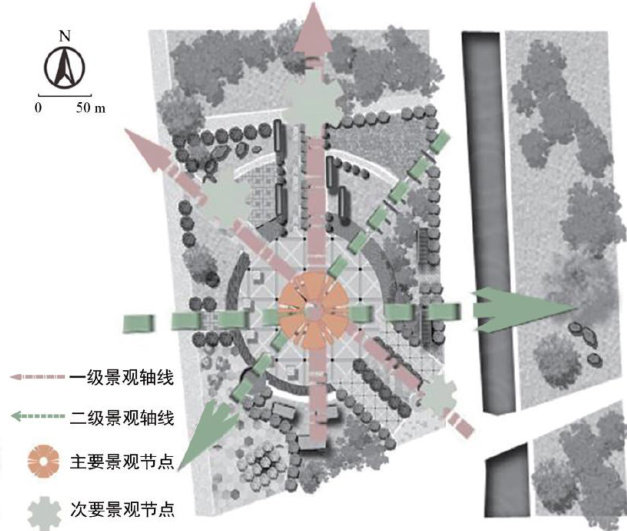
AbstractBased on the analysis of Heping Cultural Squares current land environment and the landscape demandsof the service population,design practices on the structural layout,functional zoning,and landscape nodes of the study area from the perspective of combining agricultural culture with modern square landscape planning and design was conducted.The terain of the studyarea isrelatively gentle,close toariver course,andhas good natural andtransportationconditions.Adhering to the3designprinciplesof reflecting the themeof agricultural culture, considering the behavioral and psychological needs of residents,andemphasizing the ecological environmentof the landscape,and implementing thedesign concepts of sustainable construction,high qualitypresentationand ecological friendliness,a humanizedsquare space with the characteristics of regional agricultural culture is created.The landscape structure of the research area isarranged ina four-axisand four-ring pattern (4landscapeaxes,4 landscapenodes).The landscapefunctional areas are mainly divided into5zones,including theagricultural culture exhibition area,the agricultural culture leisure area,and the agricultural culture experiencearea.Agricultural culture elementsarepresented through formssuch as the 24 solar termssculptures,relief wals,andagricultural culture stones.Adopt acomposite planting structure,and rationally combine landscape tree species with beautiful tree shapes andcolorful leaves with native tree species.This article providesa reference for the integrated constructionof agricultural culture and square landscape design.
Keywordsagricultural culture; agricultural cultural landscape; square landscape design;landscape node
广场作为市民活动的核心场所,不仅是城市景观的重要组成部分,也是城市文化展现的物质载体,以及地域文化传承的重要媒介[1-2]。(剩余5462字)