基于复杂网络与机器学习的深圳市鸟类栖息生态网络构建

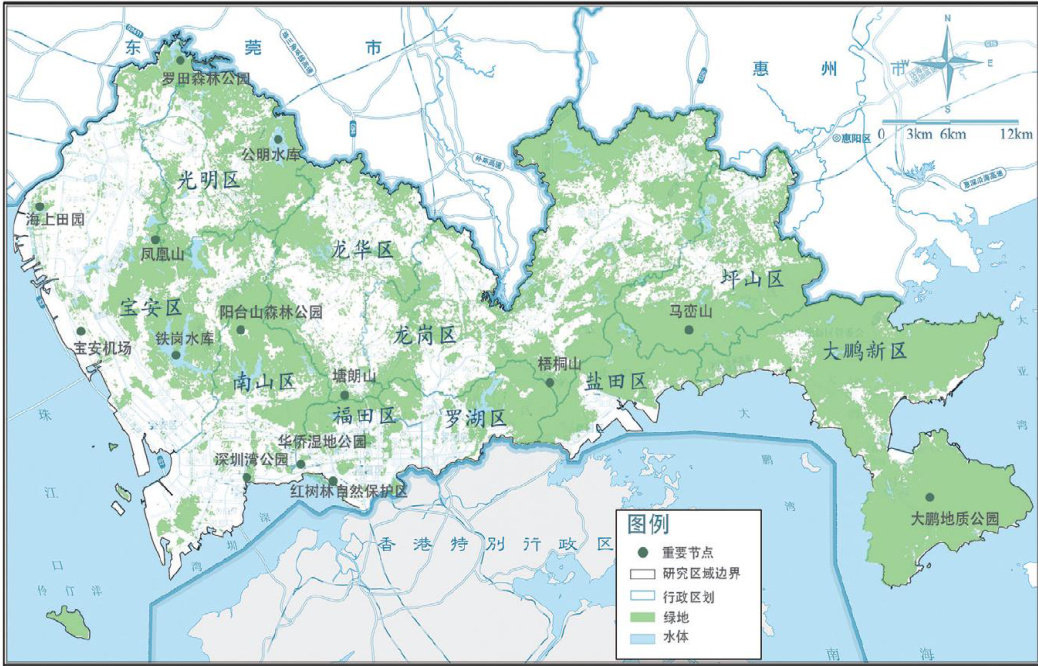
打开文本图片集
Abstract
Urbanareas serve as critical hotspots for biodiversity conservation.Constructing and preserving urban ecological networks from a species-centric perspective is of significant importance for mitigating threats to species survival within cities,enhancing species diversity,and achieving urban sustainable development goals.This study employs birds as indicator species,integrating complex network theory with random forest modeling to establish a bird habitat network in Shenzhen and to analyze its spatial patterns in relation to built-environment thresholds.The network comprises 135 nodes and 7427 weighted edges,exhibiting small-world properties and high connectivity density.Random forest analysis reveals that anthropogenic disturbances contribute 40.3% ,with urban proximity and nightime light intensity showing significant effects.Among habitat factors, adistance of 960.53m fromwaterbodiesservesasa keythreshold,whilea proportion of 7.08% natural grassland yields the highest efficiency in supporting diversity. Based on the findings,a management framework of'area differentiation-node prioritization' is proposed,along with an ecological network structured as'one core and three corridors', offering a quantitative paradigm for advancing biodiversity conservation and sustainable development in high-density urban settings.
Keywords
Ecological network; Biodiversity; Ecological restoration; Complex network;Random forest
文章亮点
1)融合复杂网络与机器学习方法,从鸟类物种共现视角构建城市栖息地生态网络,更真实刻画高密度城市中鸟类栖息地的空间连通结构。(剩余14719字)