明清首蓿植物图考

打开文本图片集
中图分类号:S541.092 文献标识码:A 文章编号:1007-0435(2026)02-0501-08
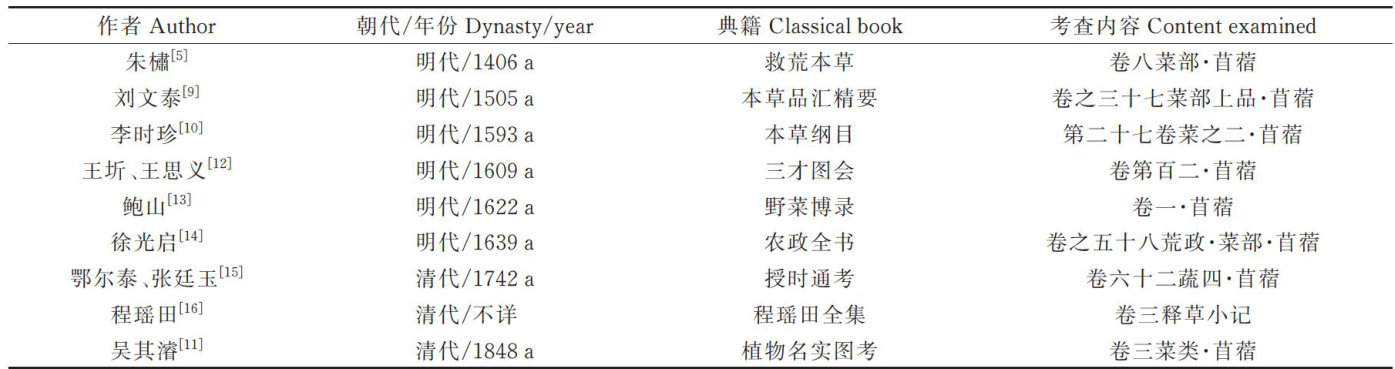
Abstract:Botanicalillustrations,often hailed as“botanical portraits”playan indispensable role in publications by serving as the finishing touch that communicates scientific essence and aesthetic value of plants.China emerges as the earliest practitioner of botanical illustration globaly,with records dating back to the Tang Dynasty. The earliest alfalfa ilustration appears in Zhu Su’s Jiuhuang Bencao from the early Ming Dynasty, representing the world's first documented alfalfa drawing.Approximately a century later,Liu Wentai's Bencao Pinhuijingyao featured similar alfalfa illustrations.Through investigation,both Zhu Su and Liu Wentai's depictions are identified as Medicago satioa;Li Shizhen’s Bencao Gangmu introduced distinct alfalfa ilustrations, which textual evidence is confirmed as Medicago hispida. By the late Qing Dynasty,Wu Qijun’s Zhiwu Mingshi Tukao presented three diferentiated alfalfa illustrations:alfalfa (M. satiua),wild alfalfa type I (Medicago falcata),and wild alfalfa type I (M. hispida).Through textual research and literature colection,this study conducted critical analysis of 11 alfalfa ilustrations from nine Ming-Qing botanical treatises.By integrating the visual representations with their textual explanations and contemporary botanical findings on Medicago species, it hasessentiallyclarified the species identification of alfalfa depicted in Chinese botanical ilustrations from the Ming and Qing dynasties.
Key words: Wild alfalfa;Medicago falcata;Medicago satioa;Medicago hispida;Hand drawing;Illustration
我国古代对植物的研究与认知,主要源于农业生产和本草学,除把长期积累的植物学知识,逐渐用文字记录下来外,还发明了植物手绘图,以图画的形式,表达各类不同植物的特征特性,使人们更易于识别植物[1]。(剩余13525字)