面向TDICCD噪声建模的物理引导深度神经网络

打开文本图片集
关键词:TDICCD;物理引导;神经网络;噪声解耦;任务平衡损失
中图分类号:TP751 文献标识码:Adoi:10.37188/OPE.20263403.0466 CSTR:32169.14.OPE.20263403.0466
Physics-guided deep neural network for TDI CCD noise modeling
XIA Bo1,HUANG Hongl*,ZHOU Jianyong 2* ,YANG Liping1,WANG Tao² (1. Key Laboratory of Optoelectronic Technology and Systems of the Education Ministry of China, Chongqing University, Chongqing 40o044, China; 2. The 44th Research Institute ofChina Electronics Technology Group Corporation, Chongqing 400060, China) * Corresponding author,E-mail: hhuang@cqu. edu. cn;526821747@qq. com
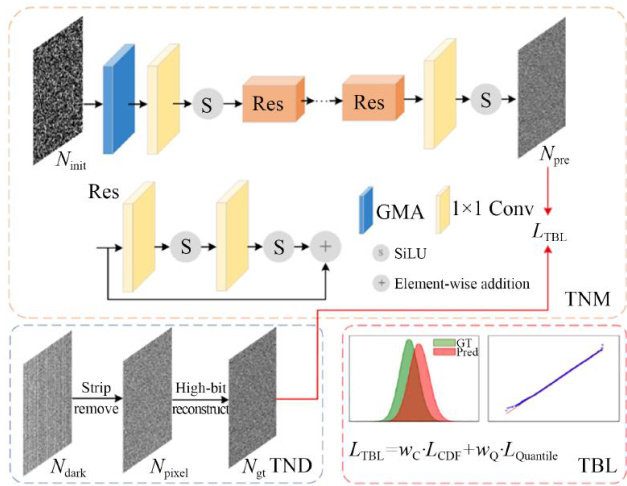
Abstract: Time-Delay Integration CCDs (TDI CCDs)are widely used in remote-sensing imaging. However,complex noise sources-including dark current,reset noise,and quantization noise-hinder accurate characterization of the signal-independent noise distribution of real sensors under low-light conditions. To address this challenge,a physics-guided deep neural network for TDI CCD noise modeling (PDNN) is proposed. Signal-independent noise is learned from dark-frame images and combined with signal-dependent noise modeled by a Poisson distribution,enabling accurate representation of the TDI CCD noise distribution in low-light scenes. First,a TDI CCD Noise Decoupling (TND) module decomposes dark-frame images into pixel-level noise with spatial independence.Next,a Gain and Multistage Adaptive(GMA) module,together with 1×1 convolutional layers in the TDI CCD Noise Modeling(TNM) backbone,maps the initial noise into a distribution space that closely matches the true noise level while preserving pixel-wise independence. Finally,a Task Balanced Loss(TBL) dynamically adjusts weighting factors to maintain training equilibrium, further improving performance. On a self-constructed dataset,the proposed method achieves an average Kullback-Leibler divergence(AKLD) of 0.106 9,demonstrating substantial improvements over existing approaches. Moreover,PSNR and SSIM obtained from models trained with synthetic noisy images closely approximate those achieved with real data.Experimental results indicate that PDNN effectively characterizes the low-light noise distribution of TDI CCDs,providing practical value for enhancing the visual quality of low-light remote-sensing imagery.
Key words: TDI CCD; physics-guided; neural network; noise decoupling; task balanced loss
1引言
时间延迟积分CCD(TimeDelayIntegrationCCD,TDICCD)在微光条件下仍具有较好的成像性能,因此被广泛应用于遥感成像领域[1-5]。(剩余16297字)