基于美国NHANES数据库分析体质量调整腰围指数与前列腺癌的相关性

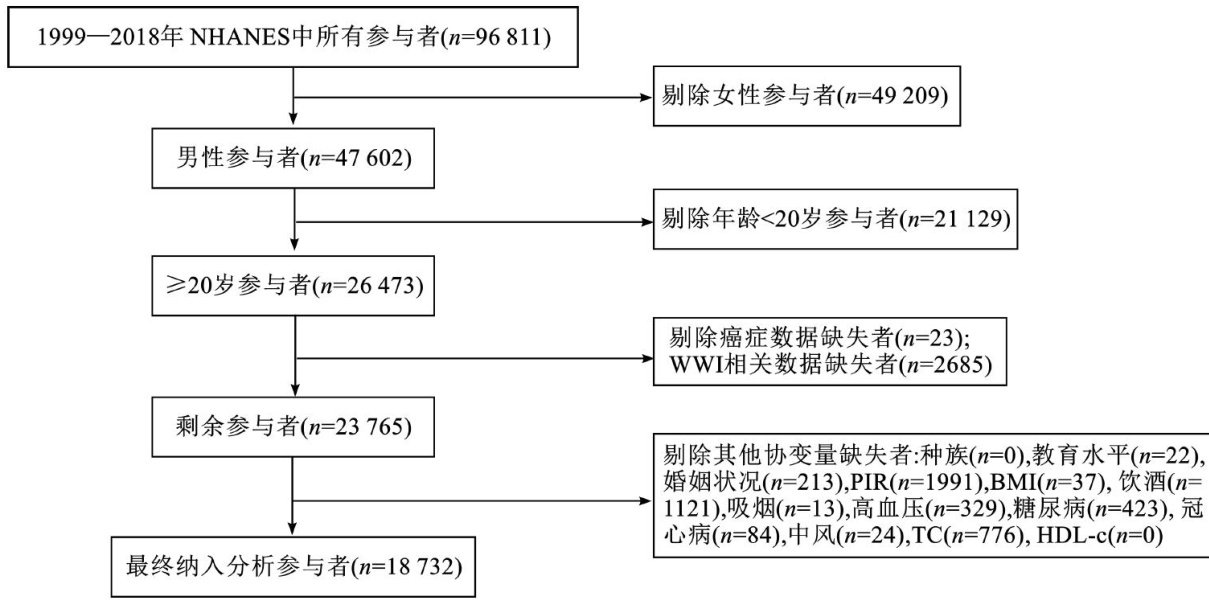
打开文本图片集
ABSTRACT:ObjectiveTo investigate the association between the weight-adjusted waist index (WWI) and prostate cancer (PCa)in order to provide reference for the screening and diagnosis of PCa.MethodsData of 18 732 men aged ⩾20 years were obtained from theUS National Health andNutrition Examination Survey(NHANES)conducted between199 and 2018. TherelationshipbetweenWWIandPCa was asssed usingamultivariate logisticregressionmodel.Astratifiedanalysis was performed acrossfour time periods:199—2006,2007—2010,2011—2014,and2015—2018.Restricted cubic splines(RCS)and subgroup analyses wereemployed to evaluate thepotentialnonlinearasociations andinteractions between WWIandPCa risk. The receiver operating characteristic(ROC)curve was utilized to compare the predictive performance of WWI with other obesity-related indicators,includingwaist-to-heightratio(WtHR),bodymassindex(BMI),waistcircumference,andbody weight.ResultsIn the fully adjusted model,each 1-unit increase in WWI was associated with a 74% higher risk of PCa( OR= (204号 1.74,95%CI:1.44-2.11 P<0.001 . Individuals in the highest quartile of WWI had nearly five times greater odds of PCa (20 compared to those in the lowest quartile (OR=4.96,95%CI:2.69-9.15 P<0.001 ).Theobserved association remained consistent across allfour survey cycles.RCS analysis revealed a nonlinear positive asociation between WWI and PCa risk. Threshold analysis indicated that when WWI⩾9.97 ,there was a significant positive correlation with PCa risk ( OR=1.39,95% (20 CI:1.18-1.64 P<0.001 ).Subgroup analyses confirmed the robustness of this association across different demographic and clinical subpopulations.Furthermore,WWI demonstrated superior discriminatory ability for predicting PCa compared to WtHR , BMI,waist circumference,and body weight (AUC=0.706,0.608,0.509,0.594,0.488, P<0.001 ).ConclusionFor the generalmale population in the US,WWIserves as an independent risk factorforPCa.This assciation has remained stable over 1999—2018,and WWIoutperforms conventional obesity indicators intermsof predictive acuracy.Therefore,individuals with WWI⩾9.97 should be prioritized for prostate-specific antigen (PSA) screening,which may enhance current screening and diagnostic strategies.
KEY WORDS: weight-adjusted waist index;prostate cancer;central obesity; National Health and Nutrition Examination Survey(NHANES)
摘要:目的分析体质量调整腰围指数(WWI)与前列腺癌(PCa)之间的关联,以期为PCa的筛查和诊断提供参考。(剩余15628字)