型钢混凝土梁柱节点试验研究及力学分析

打开文本图片集
中图分类号: TU317+.1 文献标志码:A DOI: 10.15935/j.cnki.jggcs.202503.0015
AbstractTaking a skew side-span joints of an elevated waiting room at Xi'an Railway Station as a prototype, a 1:4 scale steel reinforced concrete beam-column joint was designed,and its seismic performance was studied through the low-cyclereciprocating loading testunder bidirectional load.Itis found thatwith the load increasing,there are three failure modes,including plastic hinge at the end ofcolumn,plastic hinge at the end of the beam and shear failure at the core of the joint.The hysteresis loop of the specimen is relatively full, and the overall seismic performance is good. The cracking load of the specimen is calculated by superposition principle and elasticity theory,By comparing the theoretical values of cracking loads with the experimental one,the difference is found to be less than 20% ,indicating that the calculated cracking load has a good accuracy and can provide a reference for engineering practice.
Keywordssteel reinforced concrete,skew beam-column joint,low-cycle reciprocating loading test, hysteresis curve,anti-crack bearing capacity
0 引言
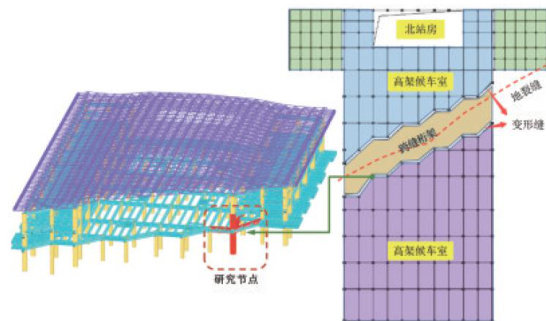
西安火车站高架候车室为大底盘多塔(单跨)框架加空间网架结构,由于西安f3地裂缝自西南向东北斜向贯穿西安火车站,导致高架候车室被该地裂缝分割为上下两部分,之间采用大跨钢桁架及钢网架跨越地裂缝,其平面形成异形结构单元[],沿地裂缝处的边节点形成一种斜交型钢混凝土梁柱节点,见图1。(剩余9247字)