基于尖点突变理论的岩溶山体稳定性分析

打开文本图片集
中图分类号:TU45 文献标志码:A 文章编号:1000-582X(2026)01-094-12
doi:10.11835/j.issn.1000-582X.2026.01.009引用格式:,,,等.基于尖点突变理论的岩溶山体稳定性分析[J].重庆大学学报,2026,49(1):
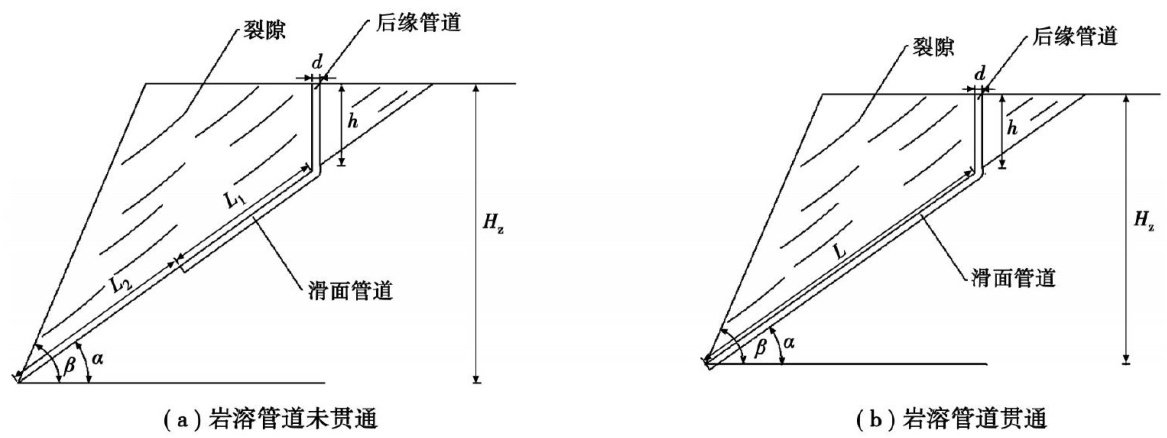
Abstract:To investigate the stability evolutionof mountainous slopes in karst regions,this studyconsiders the deterioration of pipelines along the rear edge and sliding surface,as wellas the weakening effects of water on structural planes.Taking planar sliding in karst mountains as the research object,two geological models and corresponding mechanical models are established,including unconnected and connected karst conduits.Based on cuspcatastrophe theory,thestability coeficient (FOS)and critical stabilitycoefficient (FOS*)of karst slopes under pipeline flow conditions are derived,and an energy-based criterion forabrupt instability is proposed. Results show that the displacement relationship between equilibrium and critical instability pointscan efectively determine the onset of slope failure.When conduits are unconnected,the presence of an additional sifess coefficient k in the formulations of FOS and FOS" reveals that karst conduits influence slope stability. The stability coefficient is closely related toboth k and pipeline deterioration coefficient m , showing their controlling roles in stability evolution.A case study of the Jiwei Mountain landslide verifies that the proposed energy criterion based on cusp catastrophe theory more accurately evaluates the stability of karst slopes with complex sliding surfaces, complementing the results of traditional limit equilibrium analysis.
Keywords: geotechnical enginering;mountain stability;cusp catastrophe theory; karst conduit; water hamme1 force; energy criterion
中国西南山区分布大范围的灰岩地层,其特殊的岩体结构及水文地质条件,使得大型崩滑灾害频发[3],如2009年重庆鸡冠岭滑坡4、2010年贵州关岭大寨滑坡、2014年贵州普洒滑坡等,严重制约西南岩溶山区城镇化建设,威胁人居安全与社会稳定。(剩余14853字)