基于滑模控制的两级式单相逆变电源研究

打开文本图片集
中图分类号:TM46 文献标志码:A
Research on Two-stage Single-phase Inverter Power Supply Based on Sliding Mode Control
PENG Yin-zhang,GUO Jia-hu * (School of Electrical and Information Engineering, Anhui University of Science and Technology,Huainan 232Ool,Anhui,China)
Abstract:Aiming at the problems that the intermediate DC bus voltage of the two-stage singlephase inverter power supply contains low-frequency voltage ripples, and the output voltage quality of the two-stage single-phase inverter power supply is susceptible to load changes and has poor dynamic response,this study proposes a targeted control strategy. The front-stage DC-DC boost circuit takes the full-bridge secondary LLC converter as the research object,and adopts the sliding mode control method to suppress the low-frequency voltage ripples of the DC bus voltage. The rear-stage takes the full-bridge inverter circuit as the research object, and a control scheme combining double closed-loop sliding mode control and modulation wave reconstruction technology is designed to solve the problems of the output voltage quality being sensitive to load changes and poor dynamic response,meanwhile,it further reduces the impact of DC bus voltage fluctuations on the quality of the inverter output voltage. Simulations are carried out in MATLAB/Simulink,and the results show that the low-frequency ripples of the DC bus voltage can be well suppressed,the output voltage can track the system's output reference voltage well and quickly, and the harmonic content in the output voltage is low. The system exhibits strong anti-interference ability against load disturbances. The simulation results verify the feasibility of the proposed research scheme, providing a new idea for the research of two-stage single-phase inverter power supplies.
Key words:full-bridge secondary LLC converter; sliding mode control; low-frequency ripples of DC bus voltage; modulation wave reconstruction technology
0 引言
两级式单相逆变器在应急电源1]、光伏发电[2]、车载逆变电源[3]等各个领域有着广泛的应用.因此,提高两级式单相逆变器的效率、功率密度和输出电能质量已成为研究的热点,
全桥LLC谐振变换器因其具备电磁隔离功能,并兼具软开关技术、高增益、高效率和高功率密度的显著优势被广泛研究和使用.作为前级升压电路,传统的全桥LLC谐振电路仍存在着不足.文献[4]中提出,为了达到高增益的设计标准,全桥LLC谐振电路中谐振电感的设计与实际应用不易实现;文献[5]中提到全桥LLC作为升压电路时,谐振腔承受的电流应力大,不利于谐振电容的选型.故文献4」、文献5提出了一种全桥副边LLC拓扑结构,在保留全桥LLC谐振电路优点的同时,还有效解决了谐振元器件选型的问题.两级式单相逆变器母线电压的低频电压纹波会引起母线电容发热,影响母线电容寿命[6,造成输出电能质量下降等问题.文献[7]提出增大母线电容来抑制母线电压低濒纹波的方法,该方法在一定程度上抑制了母线电压的低频纹波,但同时也增大了整个系统的体积和重量,不利于系统功率密度的提高,还会使前级电路的动态响应速度降低.文献[8]提出了在中间母线电容两端并联功率解耦电路,对母线电压的低频纹波抑制效果较佳,但系统和控制策略较复杂且成本较高.滑模控制(slidingmode control,SMC),作为一种非线性控制策略,其突出特点是具有极强的鲁棒性,理论上可以实现对系统参数和外界扰动的完全不敏感,提高系统的运行性能,已经被应用到DC-DC电路[9].后级逆变器对于前级电路来说相当于一个非线性负载,故前级升压电路可以采用滑模控制来抑制母线电容电压的低频纹波.输出电压能否迅速跟随目标值是评估单相逆变器性能的关键指标,这要求逆变器具备良好的稳态响应和动态响应能力,能在负载变化时展现出稳定的输出特性,并具有较强的抗干扰能力.滑模控制因其具有很好的抗干扰能力在后级逆变电路中也得到了很好的应用[10].
本文前级升压电路以全桥副边LLC作为研究对象,采用滑模控制的方法来抑制直流母线电压的低濒纹波,使输出到中间直流母线上的电压保持相对稳定.为了减小负载变化对输出电压的影响,本文基于后级全桥逆变器的数学模型设计了一种双闭环滑模的控制策略;为了进一步降低母线电压低频纹波对输出电压的影响,在此控制策略的基础上与调制波重构非线性前馈控制策略[1]相结合使用,并利用单极性倍频调制[12]发出SPWM波来驱动后级逆变电路,从而提高输出电压质量.最后通过在MATLAB/Simulink中仿真验证了整个两级式单相逆变电源控制策略的可行性.
整体拓扑结构设计
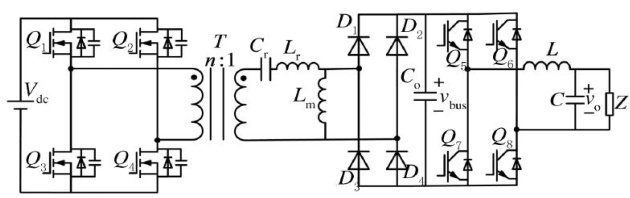
本文研究的拓扑两级式单相逆变电源的拓扑结构如图1所示.
图1两级式单相逆变电源拓扑结构图
在图1前级全桥副边LLC电路中, Vdc 为直流电源电压; Q1~Q4 为MOSFET功率开关管;T 为变压器, n 为原副边匝比; Lr 为谐振电感; Cr 为谐振电容; Lm 为附加电感; D1~D4 为副边整流二极管.前级电路起到隔离和变换电压的作用,其与传统全桥LLC的不同之处在于由 Lr,Lm 和Cr 组成的谐振网络在变压器副边,但工作原理与全桥LLC电路类似.当谐振网络中 L ,与 Cr 发生谐振时的频率称为串联谐振频率 fr ,其表达式为
在谐振网络中,当流过 Lr 与流过 Lm 的电流相等时, Lr.Lm 和 Cr 共同参与谐振,此时的谐振频率称为串并联谐振频率 fm ,其表达式为
根据开关管的工作频率 fs 与两个谐振频率的关系,变换器的工作模式可分为:欠谐振模式(2 (fmsr) ,准谐振模式( ⟨fs=fr⟩ 和过谐振模式 (fs>fr) .文献[4]中对全桥副边LLC电路的工作原理有具体的分析过程,故在此不再赘述.C 。(剩余13710字)